Strategy execution platform

Kascade

Every number defensible. Every commitment tracked.

Kascade is GTech’s strategy execution platform for the strategy management office. It carries the strategy from the retreat to the review pack on one linked model, from the national layer down to each position, and ties every figure to its data, its owner and its evidence.

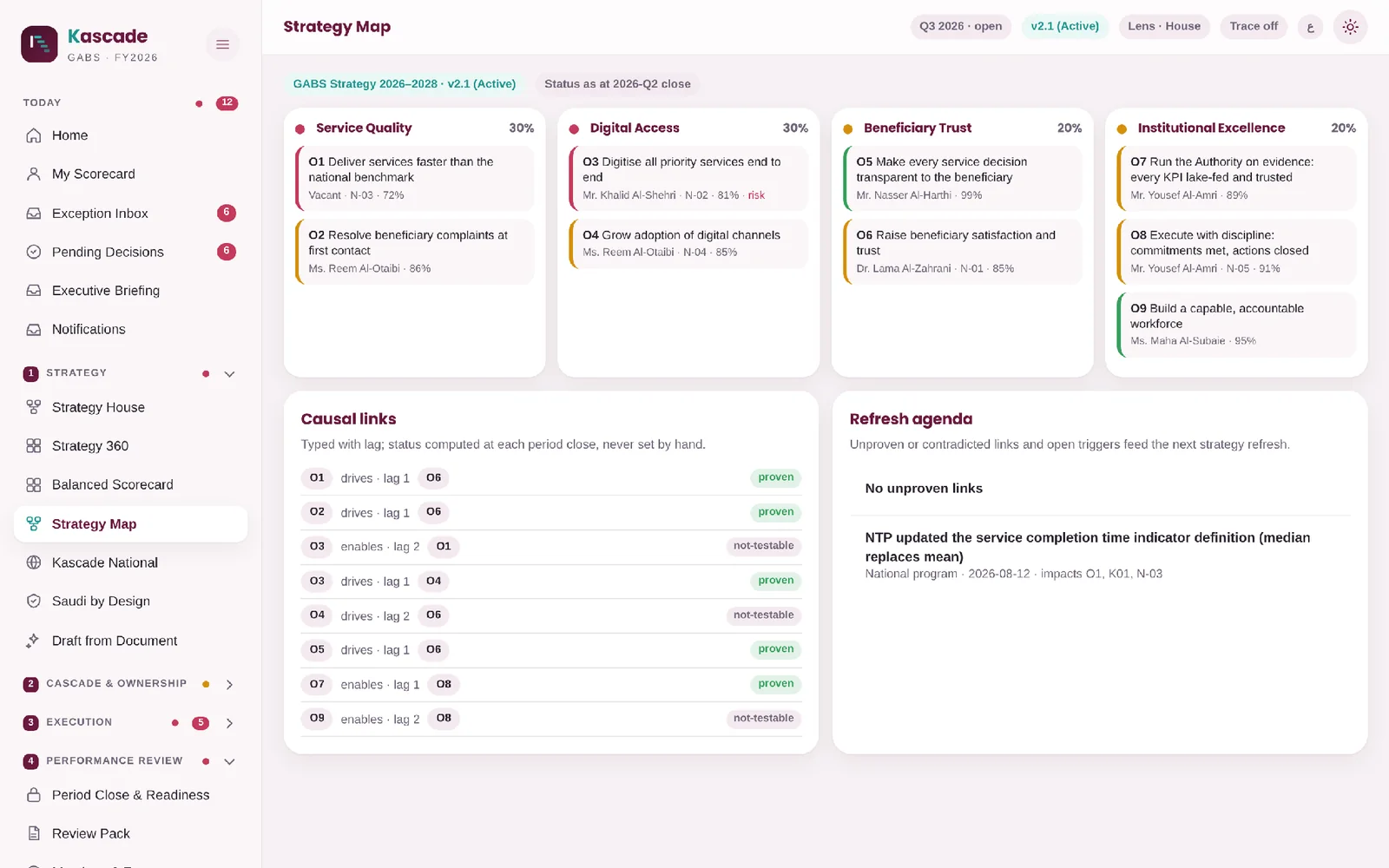
Kascade strategy map with four strategic pillars, their objectives and owners, the causal links between objectives and the refresh agenda.
Sample data

Highlights

  • A six-level cascade from national objectives to each position
  • Trust and confidence beside every value
  • Runs inside your lakehouse, on sovereign infrastructure

01The platform

Strategy execution, Saudi by design.

Most strategy tools record what people type. Kascade computes. Status, health, confidence and trust are derived from the data and never keyed by hand, and every computed number opens its own calculation: from a pillar score to the objective weights, the KPI values and the rows behind each value.

The strategy office loads its objectives on the first day instead of configuring a tool. The model, the business rules, the national reference layer, the calendars and the strategy lenses arrive ready, and the platform is fitted to each entity’s workflows, thresholds, forums and reporting lines by configuration, not by a build project.
02The cascade

Six levels, one linked model.

Pillars, objectives, KPIs, initiatives and benefits form one set of objects, and commitments and decisions attach to any of them. Every object links forward to what it serves and back to what feeds it.

  1. National layer

    Vision 2030, its realization programs and the national indicators, maintained centrally.

  2. Entity

    The institution’s pillars, objectives and corporate KPIs.

  3. Sector

    The sector or division that carries its share of each objective.

  4. Department

    Departmental objectives, measures and initiatives.

  5. Team

    Team commitments and the actions that deliver them.

  6. Position

    A scorecard for every position, generated from what it is allocated.

03One lifecycle

One loop over one dataset.

From the strategy retreat to the next refresh, every stage works on the same objects, so nothing is keyed twice between planning, delivery and review. The eighth step feeds the first.

  1. Design

    Pillars, objectives, KPIs and initiatives, shaped at the retreat or drafted from an existing document.

  2. Cascade

    Ownership allocated down the six levels, with weights and reporting lines.

  3. Measure

    Targets with method, baseline and evidence; values fed from the data platform.

  4. Deliver

    Initiatives, stage gates and funding releases tied to the objectives they serve.

  5. Review

    Packs that open with the decisions required, then exceptions, then everything else.

  6. Decide

    Decisions recorded with their expected impact and checked on the date set.

  7. Realize

    Benefits declared at charter and tracked after the initiative closes.

  8. Refresh

    Unproven links and changed national indicators feed the next strategy cycle.

04Built-in discipline

The rules live in the product, not in a policy document.

Five disciplines run through every cycle. When a step breaks one, Kascade refuses it and names the rule that applies.

  1. Targets carry method, baseline, evidence and confidence

    A new target saves only with its method and rationale. Advisory ranges from the trend, peers and national targets sit beside the field and are never filled in automatically, and a locked period cannot be revised.

  2. A trust score sits beside every value

    A value accepted without evidence carries a low trust score and holds its KPI at amber, so a green built on weak data cannot exist. The owner and the approver of a value are never the same position.

  3. Commitments gate the review pack

    The executive review pack will not generate while a commitment due in the period is still open. Each executive’s record of commitments met, missed and rescheduled is computed from the ledger, not self-reported.

  4. Decisions declare an impact and are checked

    A decision records what it should move, in which direction, by how much and when to check. On that date Kascade compares what happened with the claim and reports the result in the next pack.

  5. Benefits are declared at charter and tracked after closure

    An initiative charter needs a target KPI, an expected change and a window before it can be approved. Funding releases follow stage gates, and the benefit stays open after the initiative closes until its window ends.

05Inside Kascade

Built to be used every week, not opened once a quarter.

The executive sees less

Leaders receive exceptions only, each with its reason and the rule behind it. Scorecards are generated from each position’s allocation, delegation moves approvals but never ownership, and review packs open with the decisions required.

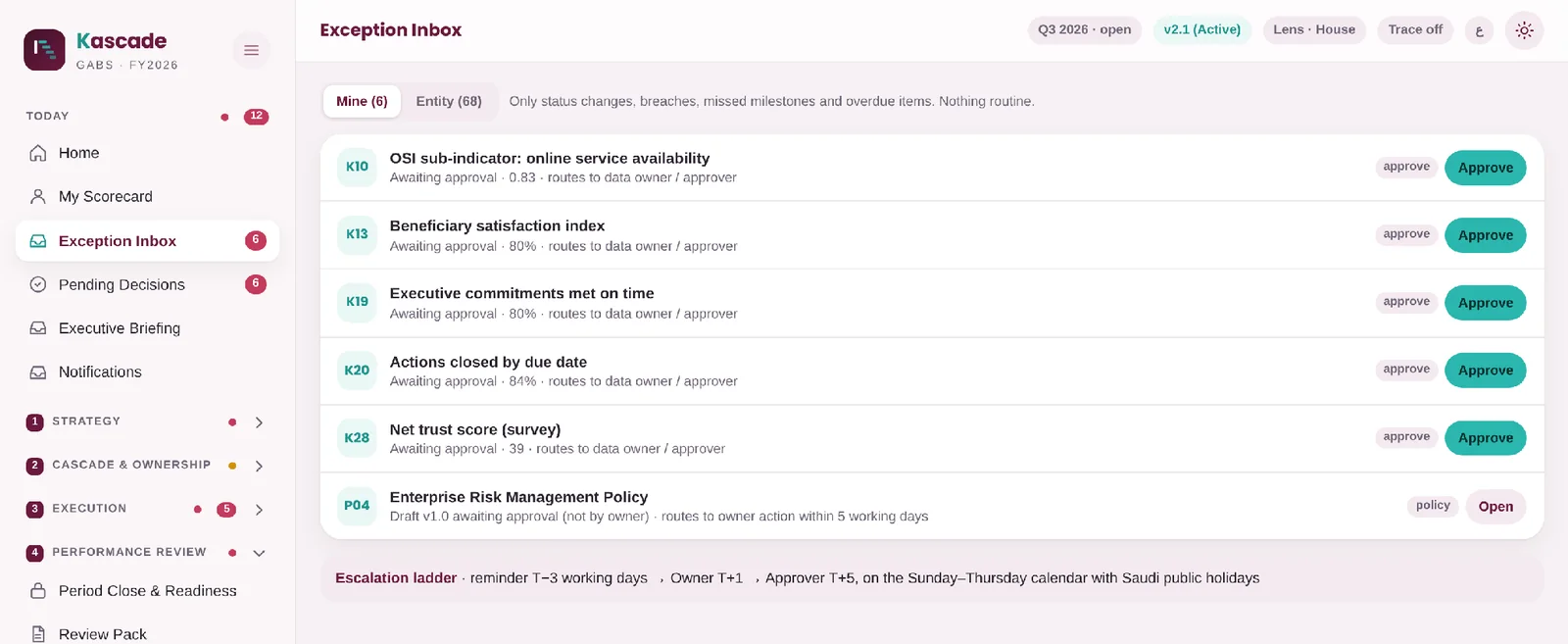
Kascade exception inbox listing six items awaiting the user, each with its KPI code, status and an approve or open action, above the escalation ladder on the Sunday to Thursday calendar.
Sample data

Every value explains itself

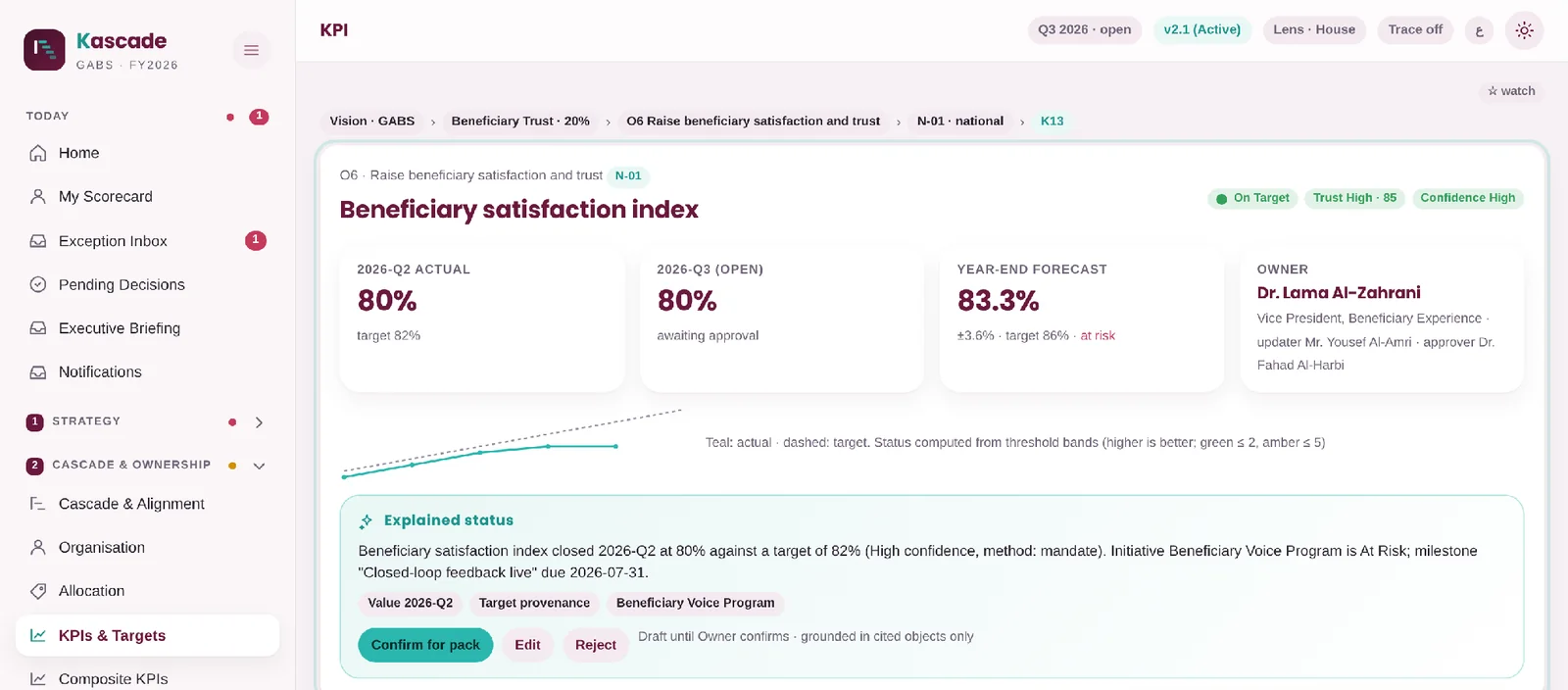
Each KPI shows its actual, forecast, owner, trust and confidence. A status explanation is drafted from the cited objects and stays a draft until the owner confirms it for the pack.

Kascade KPI page for a beneficiary satisfaction index, showing the quarter’s actual and open values, the year-end forecast, the owner, trust and confidence badges, a trend line and an explained status awaiting the owner’s confirmation.
Sample data

Inside your lakehouse

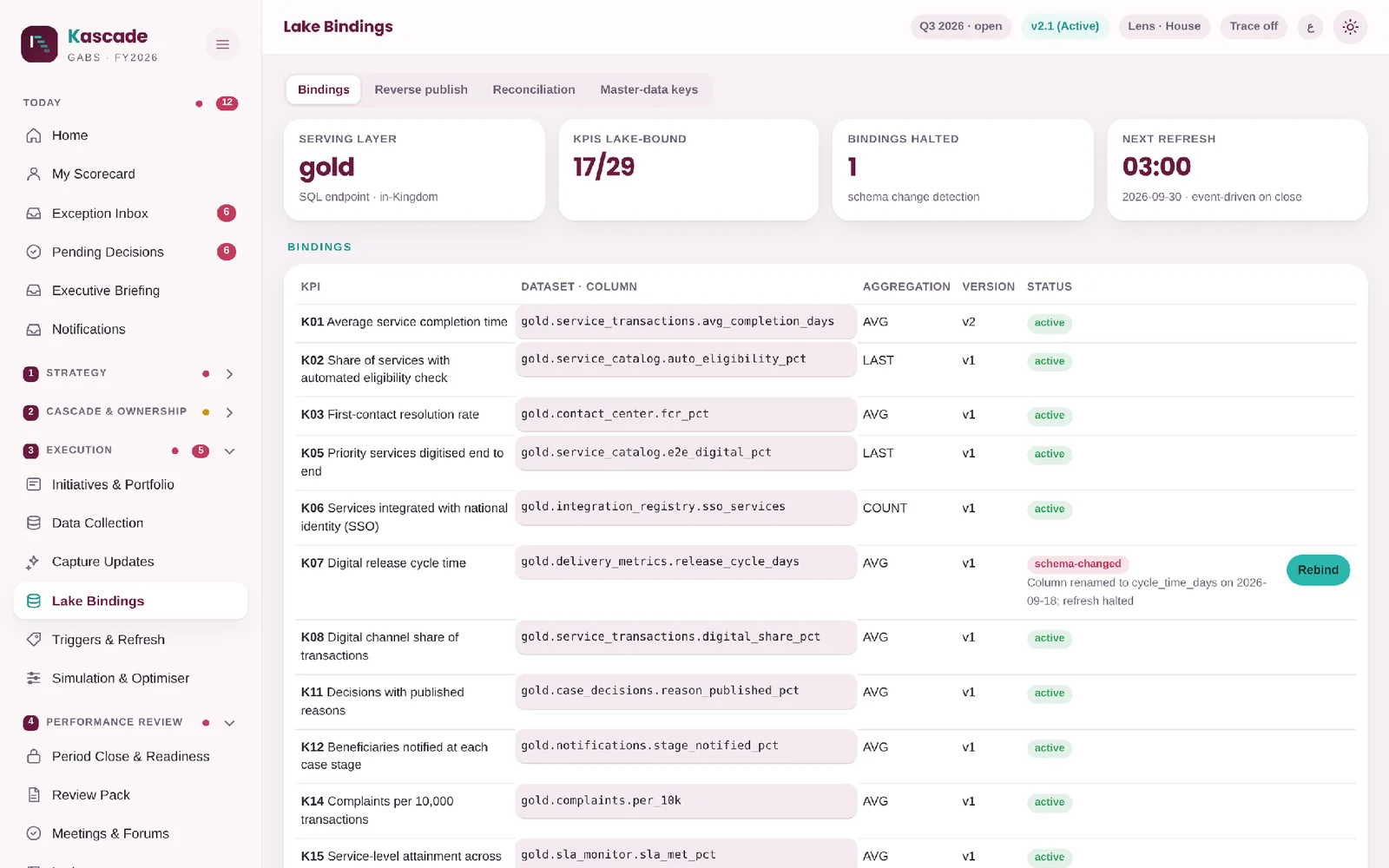
Kascade runs as a plugin inside your lakehouse. It reads governed datasets in place and writes status, exceptions and commitments back as tables you can query, with no second copy of the data and no second security model.

Kascade lake bindings screen mapping each KPI to a governed dataset column with its aggregation, version and status, including one binding halted after a schema change.
Sample data

Fitted, not built

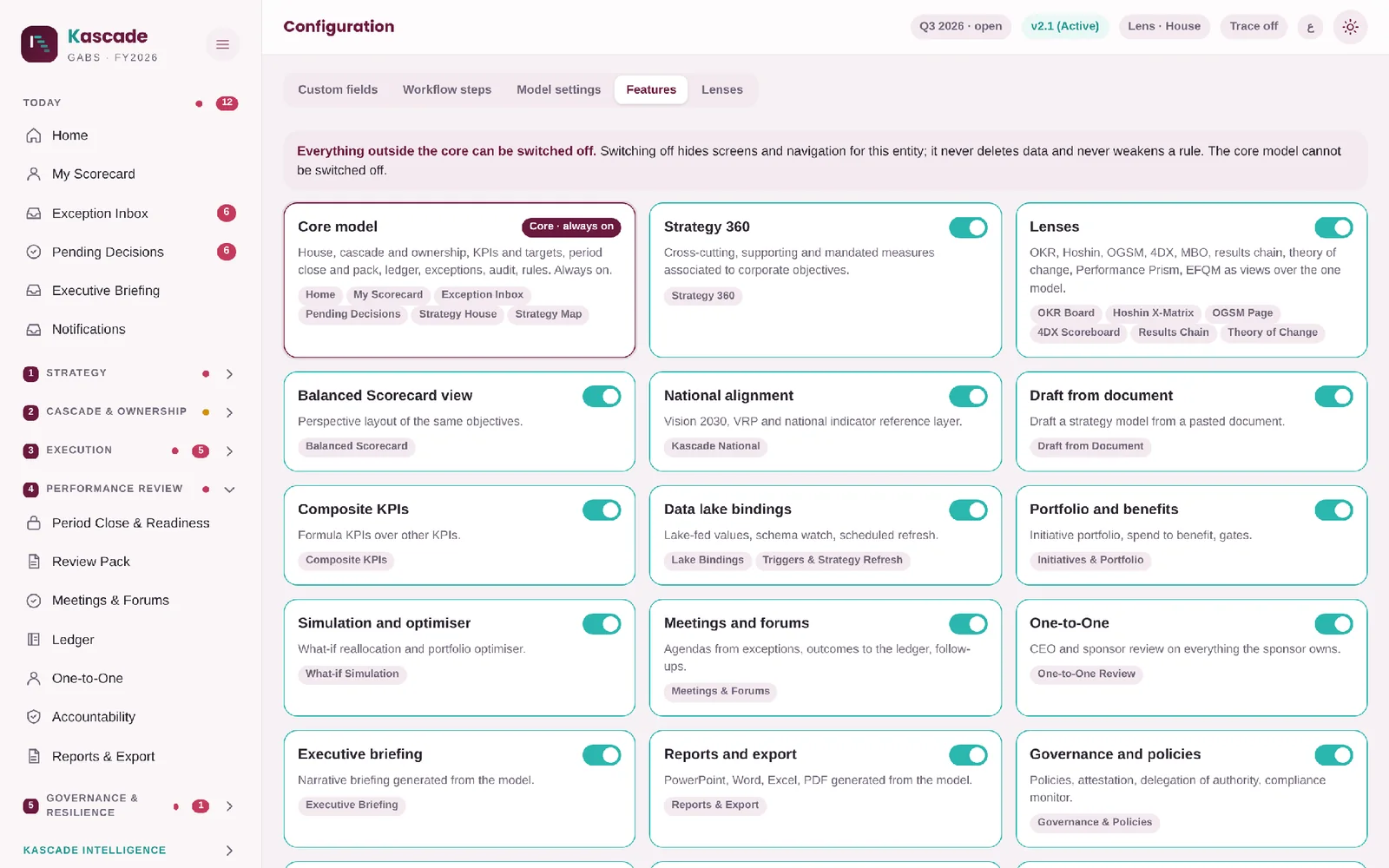
Everything outside the core can be switched on or off for each entity, from the balanced scorecard view and simulation to meetings, briefings and portfolio management. The core model always stays on.

Kascade configuration screen with the always-on core model and switchable features such as contributing strategies, lenses, national alignment, draft from document, data lake bindings, simulation, meetings and reports.
Sample data

06Strategy lenses

One model, read through the method you already use.

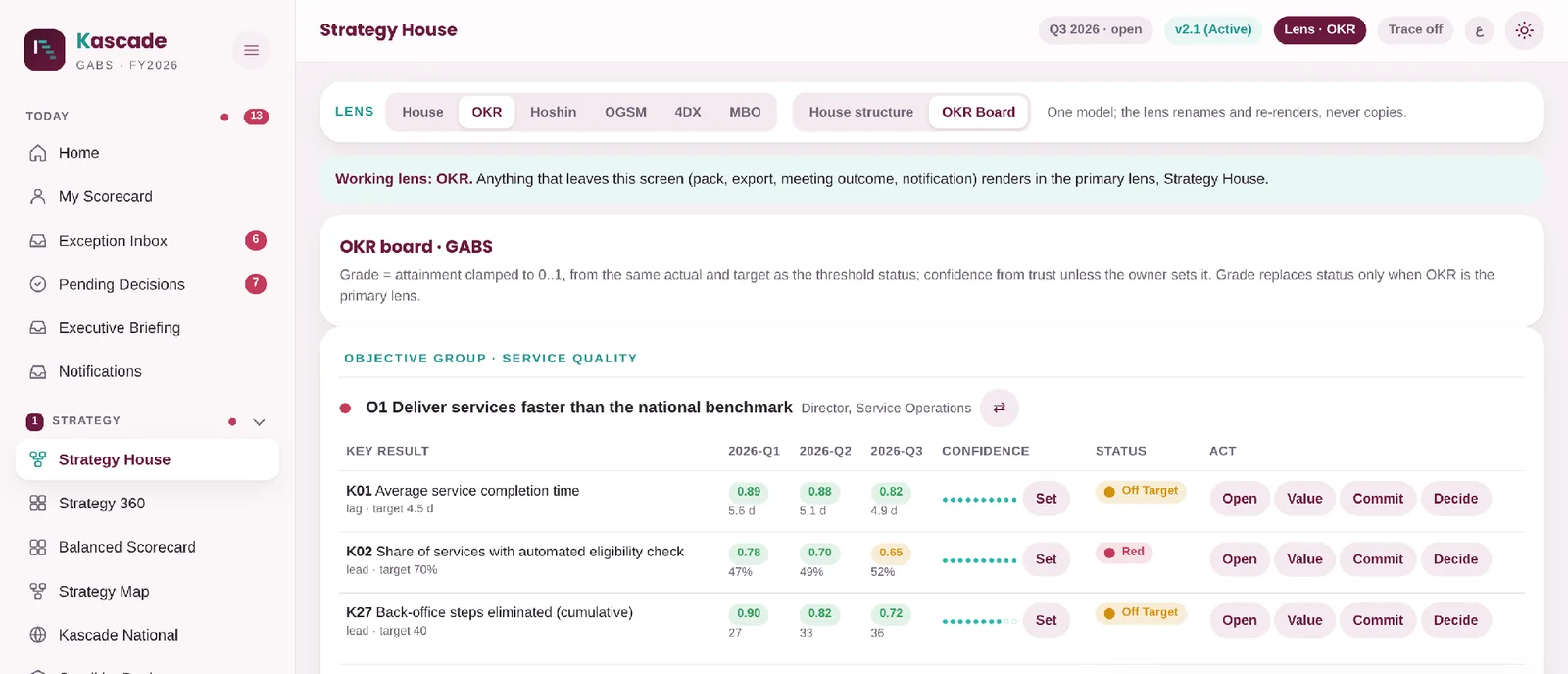
Six primary lenses show the same objects and the same score in their own terms, in Arabic and English. A lens relabels and rearranges; it never hides, creates, deletes or re-scores an object, so a red cannot disappear by changing the view.

  • Strategy House
  • OKR
  • Hoshin Kanri
  • OGSM
  • 4DX
  • MBO

Reference lenses add a results chain for program reporting, a theory of change, performance prism coverage and an EFQM self-assessment. A balanced scorecard view and a strategy map are built in.

Kascade strategy house viewed through the OKR lens: objectives with their key results, quarterly grades, confidence and status, and actions to open, value, commit or decide.
Sample data

07Kascade Intelligence

AI proposes. A named person decides.

Kascade Intelligence drafts status explanations grounded only in the objects it cites, prepares executive briefings, runs what-if scenarios on the portfolio and helps turn an existing strategy document into a first model for the retreat.

A proposal becomes a value, a target or a decision only when a named position accepts it, and every acceptance is logged. The AI runs inside the same boundary as your data.

08Saudi by design

Built for how institutions in the Kingdom plan, report and decide.

  • A maintained national reference layer

    Vision 2030, its realization programs, sector objectives and national indicator definitions are maintained centrally. When the reference layer changes, every linked objective receives a review task.

  • The Kingdom’s calendar

    Hijri and Gregorian dates, the Sunday to Thursday week, public holidays and reporting deadlines are built into every period, reminder and escalation.

  • Sovereign deployment

    One build runs on sovereign cloud, in your own data center or on-premise, with compliance mapping shipped with the build and the AI inside the same boundary.

  • Built and supported in the Kingdom

    The product team, the Arabic interface, terms in Saudi riyals and the response to the most urgent incidents are local by construction.

09Portfolio and benefits

Every riyal traced to an outcome.

Funding releases follow stage gates, spend reconciles against declared benefit on the portfolio view, and unlinked spend above the agreed threshold holds the period close.

10Editions

An enterprise edition, and editions in your sector’s language.

Every edition runs on the same core. Sector editions carry the sector’s own measures, mandates and terms, in Arabic and English.

  • Enterprise

    The full model for any institution: cascade, measurement, delivery, review and benefits on one core, fitted to your workflows by configuration.

  • Healthcare

    The measures, mandates and vocabulary of health providers and clusters, from care quality to patient experience, on the same model.

  • Financial services and banking

    The measures, mandates and reporting lines of banks and financial institutions, on the same model.

Arabic and English

See your own objectives in Kascade.

Ask for a working session with your objectives loaded into the model and your reds explained by the end of it.