AI-Driven Enterprise
Patient experience operations and command
Patient Experience 360
Fix it while the patient is still in the building.
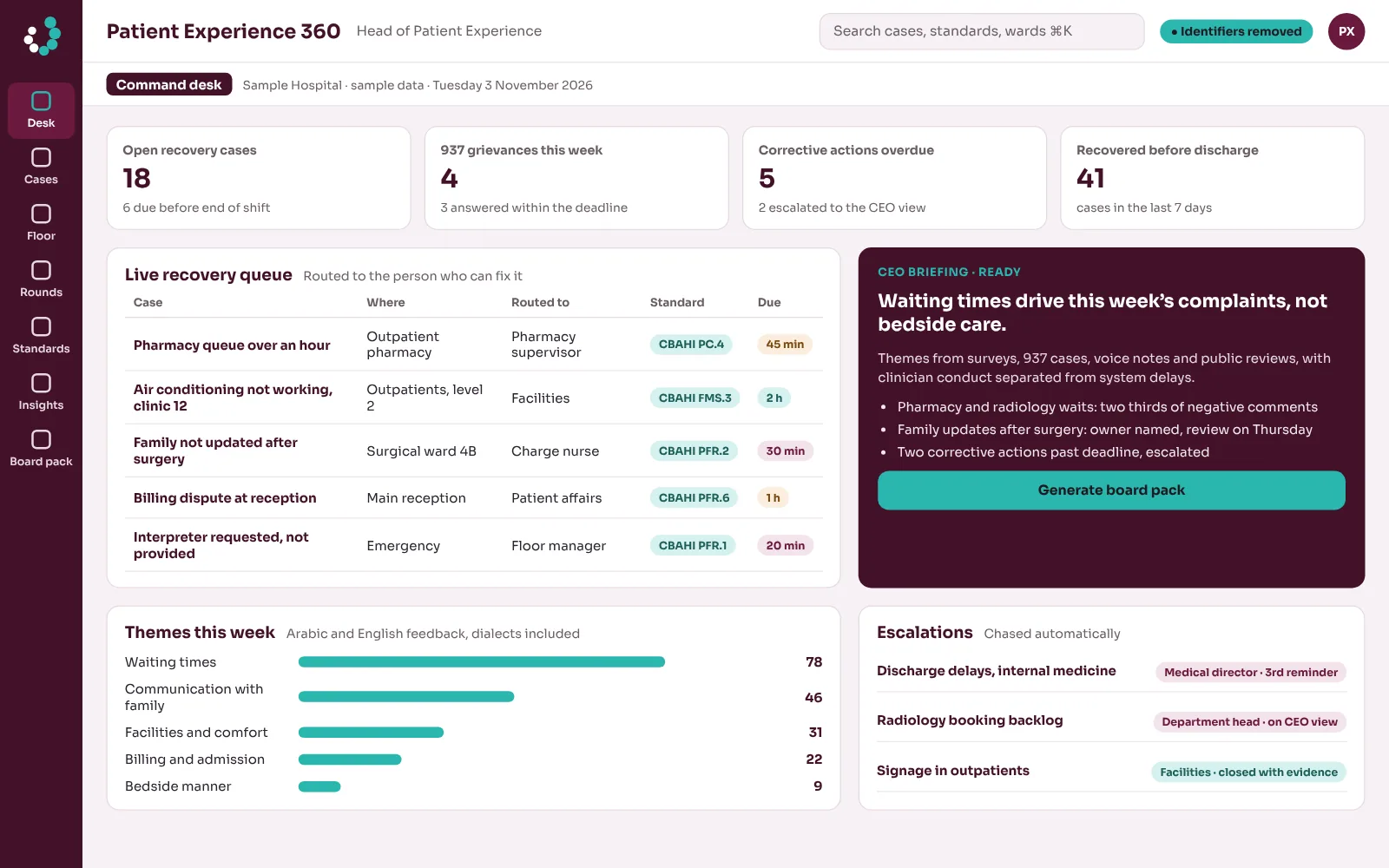
Patient Experience 360 is GTech’s patient experience operations platform, built for Saudi hospitals. Survey programmes tell a hospital what went wrong weeks after discharge. Patient Experience 360 works beside them in real time: it reads every complaint and comment in Arabic and English, sends each issue to the person on the floor who can fix it, maps it to the standard it touches and keeps the CEO briefed. The patient experience office finally gets authority to match its accountability.
Highlights
- Service recovery routed to the floor, with a deadline for every case
- Every grievance mapped to CBAHI, the Patient Bill of Rights and Ada’a
- Patient identifiers removed before any AI processing
Patient experience leaders carry the accountability without the authority.
The Chief Experience Officer answers for every complaint, yet the levers sit with clinic directors, nursing and facilities. Survey reports arrive long after the patient has gone home. When a 937 grievance is escalated or a sensitive complaint lands, the office falls back on phone calls, messaging groups and spreadsheets to piece the story together.
Meanwhile the same delays repeat in the next clinic and on the next shift. Patient experience changes when the office can act on a complaint the moment it arrives, and when leadership can see who has acted and who has not.
Five components, one command desk.
Each component is useful from the first weeks, and each one makes the next stronger.
-
Executive command desk
A chief of staff for the head of patient experience: a CEO briefing in one click, committee actions chased automatically, and rounding notes dictated by voice and turned into tasks.
-
Listening and privacy gateway
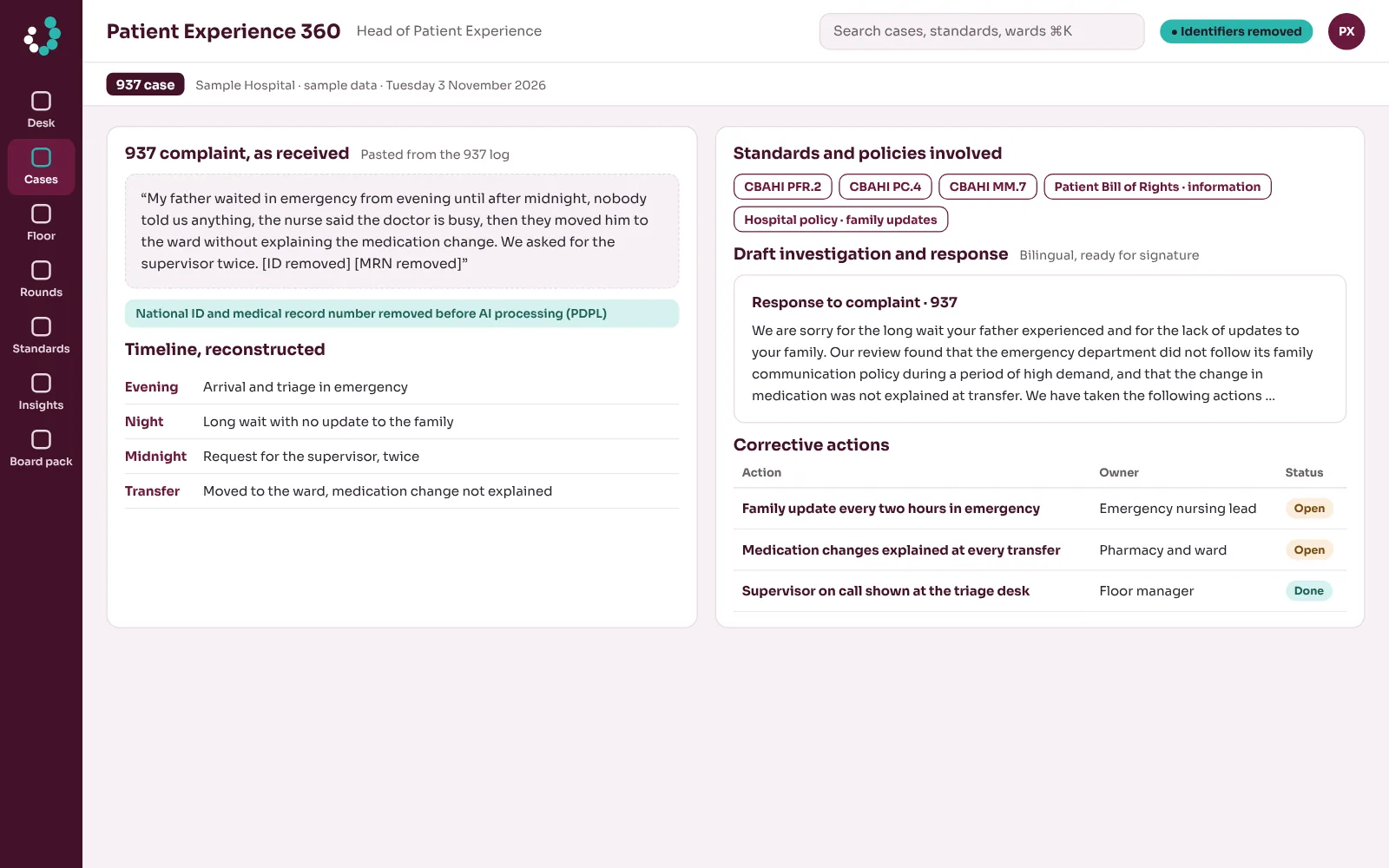
Feedback arrives as file uploads from 937 logs and existing survey programmes, with no IT project. National IDs, Iqama numbers and medical record numbers are removed before any AI processing.
-
Healthcare and dialect intelligence
An engine tuned for clinical English mixed with Saudi Arabic dialects. It separates a doctor’s bedside manner from the system delays around them, so clinicians see fair findings rather than raw scores.
-
Accreditation and governance mapper
Every grievance and operational failure mapped to CBAHI standards, the Patient Bill of Rights and Ada’a health indicators, with corrective and preventive action logs prepared for the quality office.
-
Front-line recovery
Actionable tickets routed in real time to floor managers and charge nurses, each with a resolution deadline the hospital sets.
What leaders see on day one.
Four moments show how differently the office works once the platform is in place.
-
A 937 case reconstructed
Paste an unstructured 937 complaint and the platform builds the timeline, names the hospital policies and CBAHI standards involved, and drafts a bilingual investigation and response letter ready for signature.
-
Follow-up that does not depend on one person
Corrective actions are chased by e-mail and message automatically, and owners who miss their deadline appear on the CEO’s escalation view. The head of patient experience gains authority without personal conflict.
-
Voice to action on the rounds
A short Arabic voice note about a broken air conditioner and a slow pharmacy queue becomes two tagged tickets, one for facilities and one for the pharmacy, each with its root cause.
-
The board pack in one click
A week of mixed feedback becomes an executive memo with the interventions that matter, accountability by department and a view across facilities.
Beyond the survey report.
| Survey programmes on their own | With Patient Experience 360 | |
|---|---|---|
| Timing | Reports after the patient has gone home | Recovery while the patient is still in the hospital |
| Ownership | A score for the department | A ticket for the person who can fix it, with a deadline |
| Clinicians | Raw scores that mix care with waiting times | Findings that separate bedside manner from system delays |
| Accreditation | Evidence assembled by hand before each visit | Every case mapped to CBAHI and Ada’a as it happens |
| Leadership | A quarterly presentation | A CEO briefing in one click, every week |
Built around the Kingdom’s rules.
Patient identifiable information is removed at the gateway before any AI processing, in line with the Personal Data Protection Law and the national data management standards. The platform is designed to run on Saudi-certified cloud, so patient data stays in the Kingdom.
It is an administrative and operational tool rather than a medical device, so adopting it does not wait on medical device approval. Patient Experience 360 works alongside the survey programmes you already run and reads their results.
Live without an IT project, then deeper by stage.
-
Command desk first
The command desk runs on its own: file uploads from survey programmes and 937 logs, voice notes and public reviews, with reporting, 937 case files and action tracking from the start.
-
Automated feeds
Scheduled file transfers, short patient pulses by message and public sentiment collected as it appears.
-
Full orchestration
Integration with the hospital information system through HL7 and FHIR, for the patient’s journey in real time, early intervention in sensitive cases and live feeds to the command center.
Revenue protected, not another overhead.
-
Patients who stay
Service failures caught in the moment mean fewer patients leaving for another hospital.
-
Smoother billing
Front-desk disputes resolved early, before they delay billing or insurance claims.
-
Indicators and reputation protected
Fewer missed Ada’a indicators, fewer escalated grievances and fewer public incidents.
-
Connected to the command center
Cases, themes and recovery times flow into HECC 360 and ECC 360 beside the hospital’s other measures.
The operations layer beneath the experience programme.
Experience 360 runs the experience programme across a health group: listening, care paths and improvement, measured over time. Patient Experience 360 is the operations layer inside each hospital: the complaint caught today, the ticket on the floor, the 937 case closed and the CEO briefed this week.
Hospitals can start with either. Together, today’s recovery feeds tomorrow’s improvement, and recurring themes become improvement programmes in Experience 360.
Run the office from its command desk.
Every GTech product comes with a command desk, the same across the portfolio, so a team that knows one desk can run any office. Here it serves the patient experience office: requests come in, the head assigns, the team delivers, and the desk measures it all.
-
Requests
Other departments raise requests through a short form, each with a category, priority and target time, from new to closed.
-
Tasks
The head assigns, the team works from its own lists, and reminders and escalation run automatically.
-
Committees and meetings
Agendas built from open items, AI-drafted minutes, and decisions that become tasks in one step.
-
One tracker and a weekly brief
Requests, tasks, actions and decisions in one list ranked by urgency, a weekly brief for the head, and office measures that reach the command center.
Two editions, Arabic first.
Both run in Arabic with English alongside, on the same command desk.
-
Hospital
For one hospital’s patient experience office, its quality office and its floor teams.
-
Health group
For groups of hospitals and clinics, with a view across facilities and feeds into HECC 360.
Arabic-first, with English alongside
Recover the next patient’s experience in real time.
A working session reviews how your patient experience office works today, and shows Patient Experience 360 handling a recent case from complaint to closure.